Why we walk the brine on at 25.7 and not at 26
27.0 °Bé
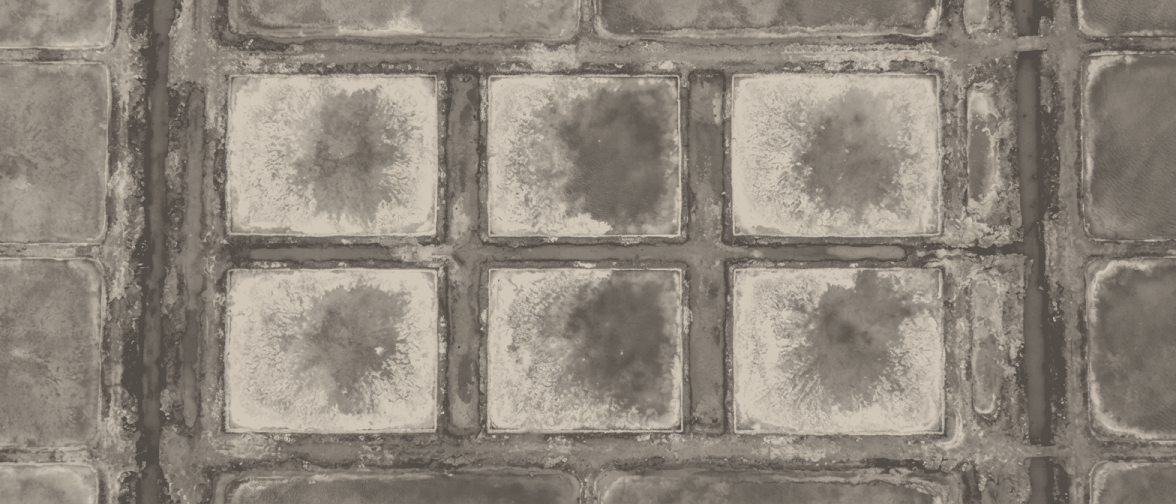
This note is printed in the colour of the crystallisers, at the density it was written about.
Saturation for sodium chloride is 25.7 °Bé. Everyone who has ever run a pan knows the number, and everyone who has run one for a second season knows that the argument is not about the number — it is about what you do in the four or five days on either side of it.
Brine sitting in pan 5 at 26.2 has already begun to drop salt. Not much of it, and not where you want it: it falls on the floor of a condenser that was never rolled hard enough to rake, and it takes the last of the gypsum down with it. Walk that brine on and you are carrying a fortnight of grit into six pans you spent April re-laying.
The reading that decides it
We take it at 07:00, before the wind gets up, with a glass hydrometer in a tall jar drawn from the middle of the pan rather than the weir end. The weir end reads high on a still night and low on a wet one, and both readings are about the last six hours of weather rather than about the pan.
- Taken
- 07:00 daily, every pan, May to September
- Instrument
- glass hydrometer, 0—32 °Bé, 0.1 divisions
- Drawn from
- mid-pan, 15 cm down, never the weir end
- Corrected to
- 15 °C, from the jar thermometer
- Walk-on
- 25.6 to 25.8 °Bé — a fortnight of pan 5, typically
A hydrometer floats higher in denser water, so the reading is a length and the whole instrument is a piece of arithmetic you can hold. It also has to be corrected for temperature: brine at 24 °C reads about 0.3 low against the same brine at 15, which in July is the difference between walking on and waiting.
The half degree is not caution.
It is the width of the gypsum window. Calcium sulphate finishes coming out between 14 and 16 °Bé, but a pan that has been rained on runs back down through that range and drops a second, finer crop that will not settle before the brine is moved. That is the crop that ends up in the coarse.
What it costs to be wrong
One crystalliser filled from an over-concentrated pan gives a season’s worth of gritty coarse — 41 t last year would have been unsellable at £6, and would have gone to the hay fields at nothing. Waiting a day costs a day. The arithmetic has never been close.
What we do when it rains
Rain puts a crystalliser down to 24 in an hour and there is nothing to be done about it except stop. The pan is left to come back up, which takes three to five dry days, and the rake is put off. In a wet September we simply stop for the year: the last rake is whenever the first heavy rain is heavy enough, and it always eventually is.
- Readings continue daily through the rain — they are the record of how long the pan takes to recover, which is the only way to plan the following July.
- Nothing is topped up to force the density back. Adding brine from pan 5 moves the problem downstream.
- The crystalliser is not drained. A wet floor re-crusts; a dry one cracks and has to be rolled again.
The works is annual, and it ends where it starts — swept in October, re-puddled, and re-flooded on the first big tide at 3.5 °Bé.